first model to guide large-scale production of ultrathin graphene
Graphene is well-known for its remarkable electronic, mechanical and thermal properties, but industrial production of high-quality graphene is very challenging. A research team at Delft University of Technology has now developed a mathematical model that can be used to guide the large-scale production of these ultrathin layers of carbon.
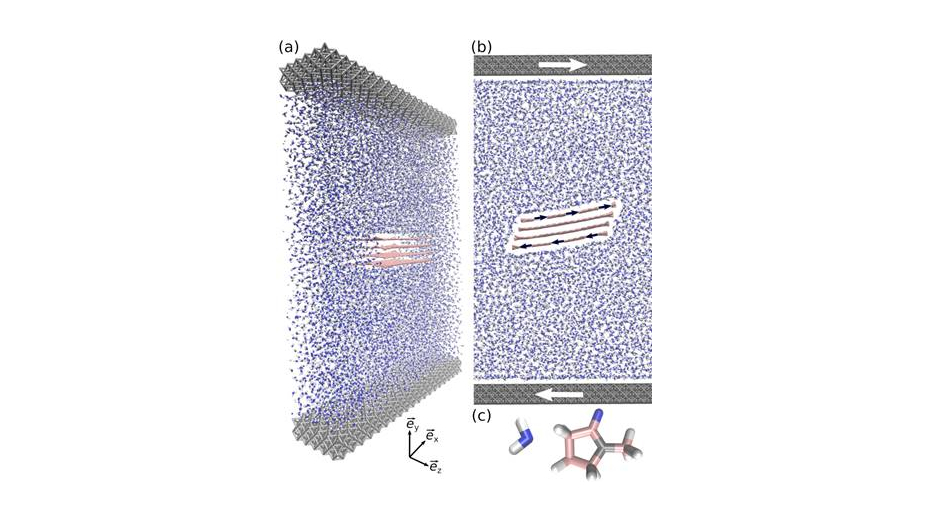
“Our model is the first to give a detailed view of what happens at the micro and nanoscale when graphene is produced from plain graphite using energetic fluid mixing,” says Dr. Lorenzo Botto, researcher at the department of Process & Energy at TU Delft. “The model will help the design of large-scale production processes, paving the way for graphene to be incorporated in commercial applications from energy storage devices to biomedicine”.
Graphite and graphene
Graphene can be made from graphite, which is a crystalline form of pure carbon, widely used for example in pencils and lubricants. The layers that make up graphite are called graphene and consists of carbon atoms arranged in a hexagonal structure. These extremely thin carbon layers possess remarkable electrical, mechanical, optical and thermal properties.
For example, a single layer of graphene is about 100 times stronger than the strongest steel of the same thickness. It conducts heat and electricity extremely efficiently and is nearly transparent. Graphene is also intrinsically very cheap, if scalable methods to produce it in large quantities can be found. Graphene has attracted much attention of the past decade as a candidate material for applications in a variety fields such as electronics, energy generation and storage, and biomedicine.
In the near future we may replace the copper wiring in our houses with graphene cables, and develop all-carbon batteries that use graphene as the main building block. However, the fabrication of high quality graphene at industrial scale and affordable price remains a challenge. A new theoretical and computational model developed at TU Delft addresses this challenge.
Read the press release here.